

Keep what matters.
Feed, spaces, forums, events, photos, polls, courses. Turn each module on or off. Build around your people, not a feature checklist.
Explore the modules
Its own address. Its own brand. Its own members.
One platform underneath, and only the parts you need.
Private and unindexed until you decide otherwise.
Good communities don’t need more software.
They need the right space to come together.
Feed, spaces, forums, events, photos, polls, courses. Turn each module on or off. Build around your people, not a feature checklist.
Explore the modulesYour logo, your colours, your domain, your words. Used exactly as you supplied them, never cropped or recoloured to fit a slot.
Make it your ownOne deployment, any number of communities. Each one a database row. Nothing about starting another needs an engineer.
Meet the foundationA community is a row, not a deployment.
Nothing about starting one needs an engineer.
your-community.success.digitalcommunity.yourdomain.comIn this category your own brand on your own domain tends to be the top tier — the one with no published price and a conversation attached before you can have it. Here it is what the first community gets, and the tenth costs a database row.
None of this is the expensive part. What costs money is the work that makes a room worth returning to, and that is what the engagement pays for. What the engagement covers
One platform underneath, and none of them
wearing our name in the address bar.
anandbodh.com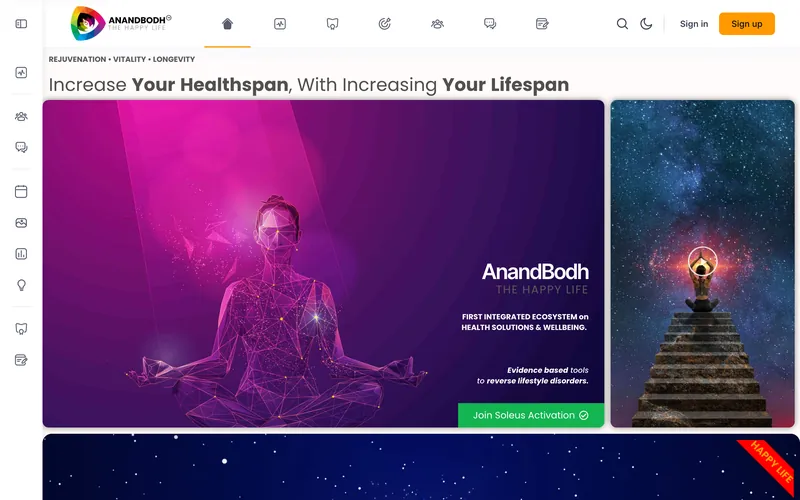
Four kinds of health and one conversation.
A site that already existed, moved onto the platform whole. Blog, calculators, courses and forums all answer on one root domain, and the address bar never changes.
mahaprayaan.com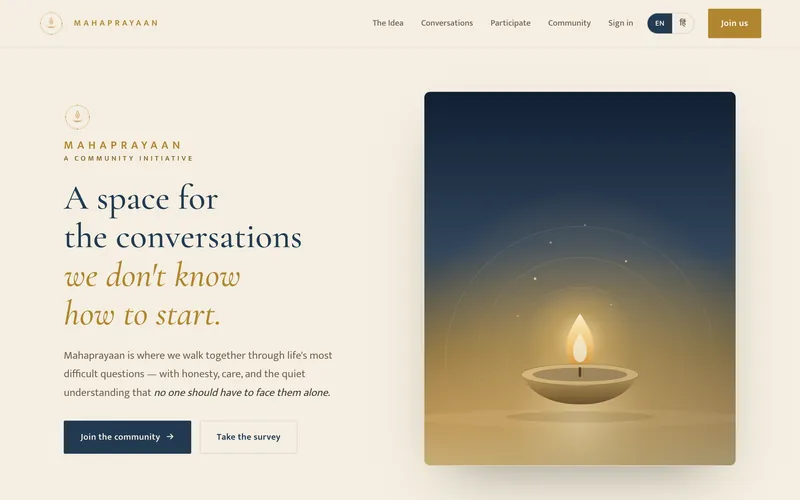
A space for conversations we usually postpone.
A front page assembled from platform sections rather than authored HTML, with nine channels open to read before anybody joins.
saving.careers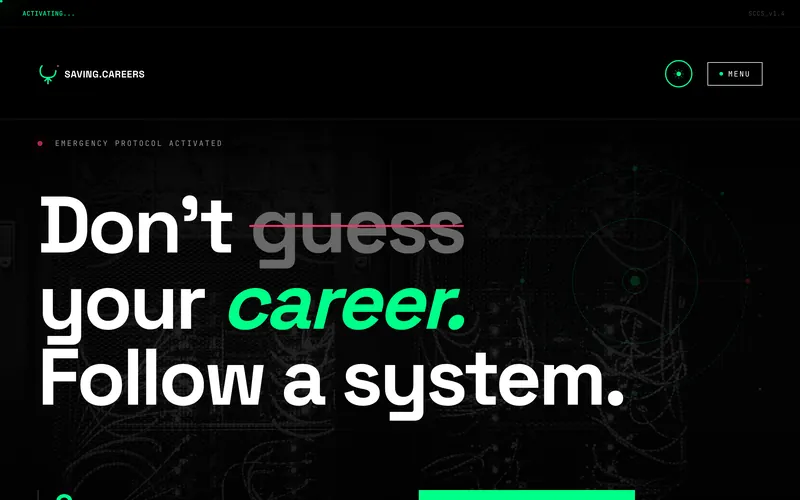
For the part of a career nobody plans for.
Its own multi-page site and its five rooms answer on one domain, one click apart, with the rooms readable before you join.
Ten communities run on this platform today. These are the three far enough along to be worth a click; the others are private, new, or both. The list grows as they do rather than as we need it to.
No deploy, no developer, no ticket.
Try it on the community below.
I have been consulting alone for nine years and the thing I have never solved is who to ask. Not about the work — about everything around it.
Both from a talk I gave to fourteen people in a room above a bank. The lag is the part nobody plans for.
Both of those are settings on a row, not a deploy. Harbourline is our demonstration community — a fictional brand with sample content, kept private and unindexed. Its layout and its posts are what it actually renders.
Most platforms ask you to trust the interface.
These three rules live in the database instead.
Not a setting and not a promise in an interface. A conversation id is not an invitation, conversations are scoped to one community, and notifications carry who wrote — never what was said.
A new community starts private and off the search engines. Being readable and being indexable are two separate switches, and both of them are yours.
One queue for reports and join requests, oldest first, with an audit log behind it. Moderation you can account for later.
The decisions a platform makes about endings
tell you more than the ones it makes about beginnings.
A host closing at midnight after an argument is a real thing that happens. Closing takes a community offline and leaves every post, comment and member record where it was, so the morning is still available.
When a community changes its address the old one is kept out of circulation permanently. An old link can lead nowhere. It can never quietly lead somewhere else that looks like you.
If a platform administrator renames, reconfigures or closes a community, that is written to a log its own host can see. An ability with no trace is indistinguishable from an intrusion.
A name for your community. An address to call your own.
Choose a starting point and the modules that fit your purpose.
Pick an accent. Name your spaces. Open the door.
Live means in production now.
In build means in active work. Nothing else is on this page.
Live rooms, points and leaderboards, and deeper host analytics are decided and not started. Anything on neither list is not built either, and will arrive in the left column with a date rather than here as a promise.
No. A community is a database row rather than a separate install, so naming it, branding it, choosing its modules and picking its theme all happen in settings. Nothing waits on a deploy.
Yes. Your community starts at an address on success.digital and moves to a domain you own whenever you are ready. Today that is a short step with us rather than a self-serve field, and your original address keeps working until the new one is verified.
Not unless you say so. New communities start private and unindexed. Being readable and being indexable are two separate decisions and both belong to the host.
A host cannot, and neither can a platform administrator. The rule is enforced in the database rather than by the interface, and message notifications record who wrote without recording what was said.
Every module switches on or off per community — feed, spaces, forums, members, messages, events, photos, polls, questions and courses. Turn off what your people will not use and it stops existing for them.
Yes. Modules and lessons carrying video, audio, PDFs and text, with drip scheduling, quizzes, prerequisites and certificates. Courses stay off until a host switches the module on, and a course can be written and edited long before anybody can see it. A lesson somebody is not entitled to open does not come back at all — the body is stored apart from the lesson row so that locking it actually locks it.
Not yet, and that is worth saying plainly rather than leaving you to find out. Your community lives in Postgres with row-level security rather than a closed format, so nothing is hostage — but a self-serve export does not exist today, and neither does member account deletion. Both are planned and neither is finished. If you need your data before they ship, ask and we will hand it over.
Yes, and it is used as you supplied it. You upload a wide logo and a square mark, each with a reversed version for dark backgrounds, plus an optional tab icon. We never crop a wide logo into a box or stretch a mark across a band to fill a slot you have not filled — a missing shape falls back to your initial or your name set in type instead. SVG is not accepted, because an SVG can carry script and every member’s browser opens it.
Nothing is deleted. Closing takes a community offline, and every post, comment and member record stays exactly where it was, so a decision made at midnight can be undone in the morning. The address is never handed to anybody else either — an old link can lead nowhere, but it can never quietly lead somewhere new.
Starting a community is free, and that is the plan every new community is on: every module, your own logo and colours, and an address at yourname.success.digital. The paid arrangement is white label — your own domain, with no Success.Digital line at the foot of your pages — and we have not set a price for it yet. There is no billing in the product and nothing is charged when you create a community.
Meet Success.Digital. Make it your own.